So far, we have learned to use artificial intelligence mainly as an interlocutor. We ask it a question and receive a text, an analysis, an image, a summary, or a piece of code in return. The value lies in the quality of the response, although the interaction often ends there.
With Agentic AI, this boundary begins to shift. Artificial intelligence can understand an objective, identify the steps required, use the tools available, and prepare the next action. It can query a system, retrieve and compare information, validate a configuration, create a draft, and submit it to the user for approval.
This introduces an AI system that can participate in processes and support their execution.
The change is particularly relevant in marketing and data management, where the main challenge is rarely a lack of information. More often, it involves everything required to make that information usable. Teams need to understand dataset structures, move between tools, coordinate different skills, and translate analysis into concrete activity.
Agentic AI can shorten this distance and create a more direct path between intention and action. To provide meaningful value, however, it needs to understand its operating context, integrate with business data and platforms, and act within clear, verifiable, and controlled boundaries.
Beyond the chatbot: a new layer of interaction with platforms
A traditional generative assistant receives an input and produces an output based on the available context. An agentic system can break an objective down into a sequence of operations, select the most suitable tools, call APIs or platform functions, and coordinate a multi-step workflow.
The difference also concerns the system’s ability to interact with its operating environment. An agent can query databases, read metadata, perform checks, use specialised tools, maintain context across different steps, and return an operational result alongside the information provided.
Imagine, for example, that a marketing manager wants to identify customers who have made at least one purchase in the past 30 days, check how many of them have a valid email address, and create an audience for a campaign.
A traditional process may require teams to:
- identify the correct tables and relationships;
- verify the quality, completeness, and format of the fields;
- define the segmentation logic;
- run a query or configure filters;
- calculate the potential audience size;
- select the destination;
- configure and start the synchronisation.
With an agentic interface, the same objective can be expressed in natural language. The agent interprets the intent, identifies the relevant sources, calls the required tools, verifies data availability and quality, builds the audience logic, and calculates a preview.
Before performing an operation that changes the system, it can present the proposed configuration, the parameters used, and the action it intends to execute. The user can then approve, amend, or reject the proposed step.
The value extends beyond reducing operational time. It changes the level of abstraction through which people access a platform’s capabilities. Users do not necessarily need to know the syntax of a query, the complete structure of a data schema, or the technical sequence of operations. They can express the result they want to achieve, while the agent translates that intent into tool calls and verifiable configurations.
Conversational interaction therefore becomes an orchestration layer connecting users, data, and platform capabilities. It complements the traditional interface by offering more direct, guided, and transparent access to operational processes.
The real value lies in the operational context
To provide meaningful value in a business environment, an agent needs more than the general knowledge of a language model. It must operate within a precise application context and understand which data is available, how it is organised, which relationships exist between tables and profiles, which tools it can use, which models are active, and which permissions the user holds.
This context involves more than providing a larger amount of information. It includes metadata, schemas, business rules, configurations, authorisations, and the current state of resources. These elements allow the agent to translate a general request into a sequence of operations compatible with the actual environment.
Without access to this context, AI can suggest a method or describe a procedure, although it may be unable to verify whether the required data exists, whether a field is suitable, whether a connection is active, or whether the user is authorised to perform a specific action.
Agentic AI therefore relies on the ability to connect a language model to operational tools through structured interfaces. The agent needs to discover the available functions, understand their parameters and constraints, call them at the right moment, and use the result of each operation to determine the next step.
Within this architecture, the language model interprets the intent and orchestrates the process, while specialised tools, APIs, and services handle execution. The Model Context Protocol, for example, defines an open standard through which an AI assistant can access data, resources, and functions exposed by external systems in a controlled way.
This integration addresses one of the main limitations affecting AI adoption in business processes, the separation between the environment where a request originates and the system where it needs to be executed. When an assistant cannot access the tools used by the team, the user needs to retrieve information manually, copy it into the conversation, interpret the response, and recreate the operation in another application.
An integrated agentic system can reduce these steps. It may work directly within the platform or make selected platform capabilities available through AI assistants already adopted by the organisation. This creates a more continuous workflow in which data, reasoning, and operations are part of the same process, while roles, authorisations, and access levels remain distinct.
Greater operational capabilities while keeping human judgement central
The idea of a system capable of taking action often draws attention to its degree of autonomy. In a business environment, a more useful question concerns which activities should be assigned to the agent, within which boundaries, and under what level of supervision.
The agent translates the user’s objective into technical operations. It identifies relevant sources, selects tools, verifies prerequisites, and prepares the action. Strategic evaluation remains with the person who understands the business context and can determine whether the proposed result is coherent, useful, and appropriate.
An audience may be formally correct while being poorly suited to the campaign. A model may use valid fields with limited relevance to the objective. A synchronisation may be technically feasible while remaining inconsistent with internal governance.
Human intervention is therefore an integral component of an agentic architecture. Reading, exploration, and preview activities can often be automated, while write, activation, and deletion operations require authorisation, explicit confirmation, and traceability.
Within a human-in-the-loop model, the agent reduces technical complexity and prepares the action. The user evaluates its relevance and decides whether to proceed. To support an informed decision, the system needs to make the consulted data, tools used, selected parameters, and proposed changes transparent.
Agentic AI in the Bytek Prediction Platform
The new capabilities of the Bytek Prediction Platform are evolving in this direction, making the full data workflow more accessible. This spans data source configuration, predictive model development, analysis, and activation. The objective extends beyond the introduction of a conversational interface and concerns how users interact with the platform’s operational capabilities.
Data Source Manager: configuring data through a guided process
The first step involves connecting and correctly configuring the data sources that will feed the platform.
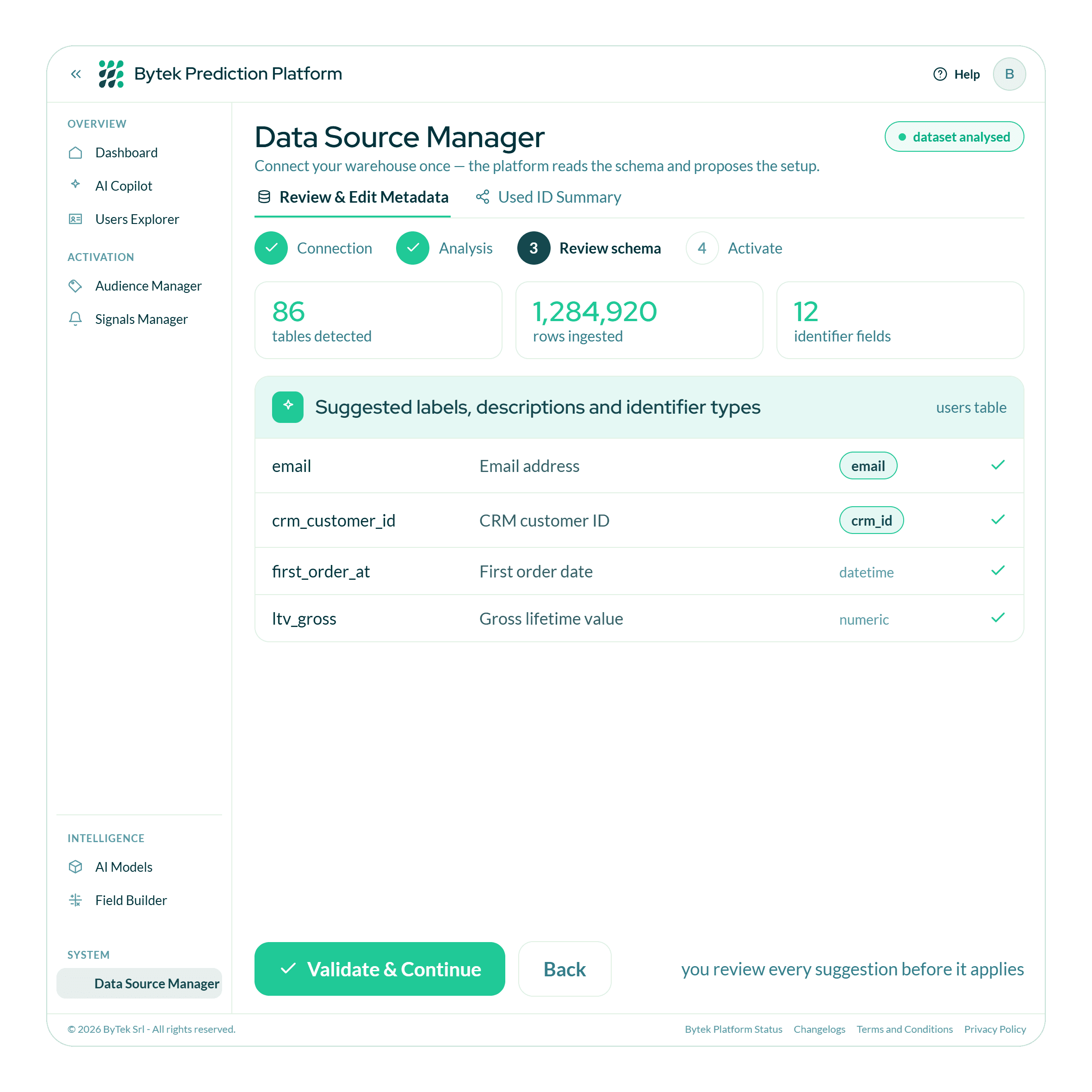
Data Source Manager guides users through dataset onboarding. It automatically analyses tables and fields, allows them to select the information to include, supports identifier configuration, and enables a review of the overall structure before activation.
For BPP users, this provides a faster way to understand which data is available and how the platform will interpret it. Users can decide which tables to include, improve field names and descriptions, correctly associate identifiers such as email addresses or customer IDs, and verify how these identifiers will contribute to profile reconciliation.
The guided process reduces the likelihood that initial configuration errors will affect later activities. An incomplete identifier definition, an unclear field, or an incorrectly selected table can compromise audiences, signals, and models. Data Source Manager makes these steps more visible and easier to control before the platform is activated.
The value also extends to collaboration between teams. Infrastructure teams retain control over the technical configuration, while marketing, analytics, and data teams gain access to a clearer and more consistent representation of the data they will use. Onboarding can therefore become the starting point of a more reliable operational process, closely connected to the rest of the platform.
AI Model Copilot: turning data into operational predictions
Once data has been configured, users can apply it to predictive models linked to concrete business objectives.
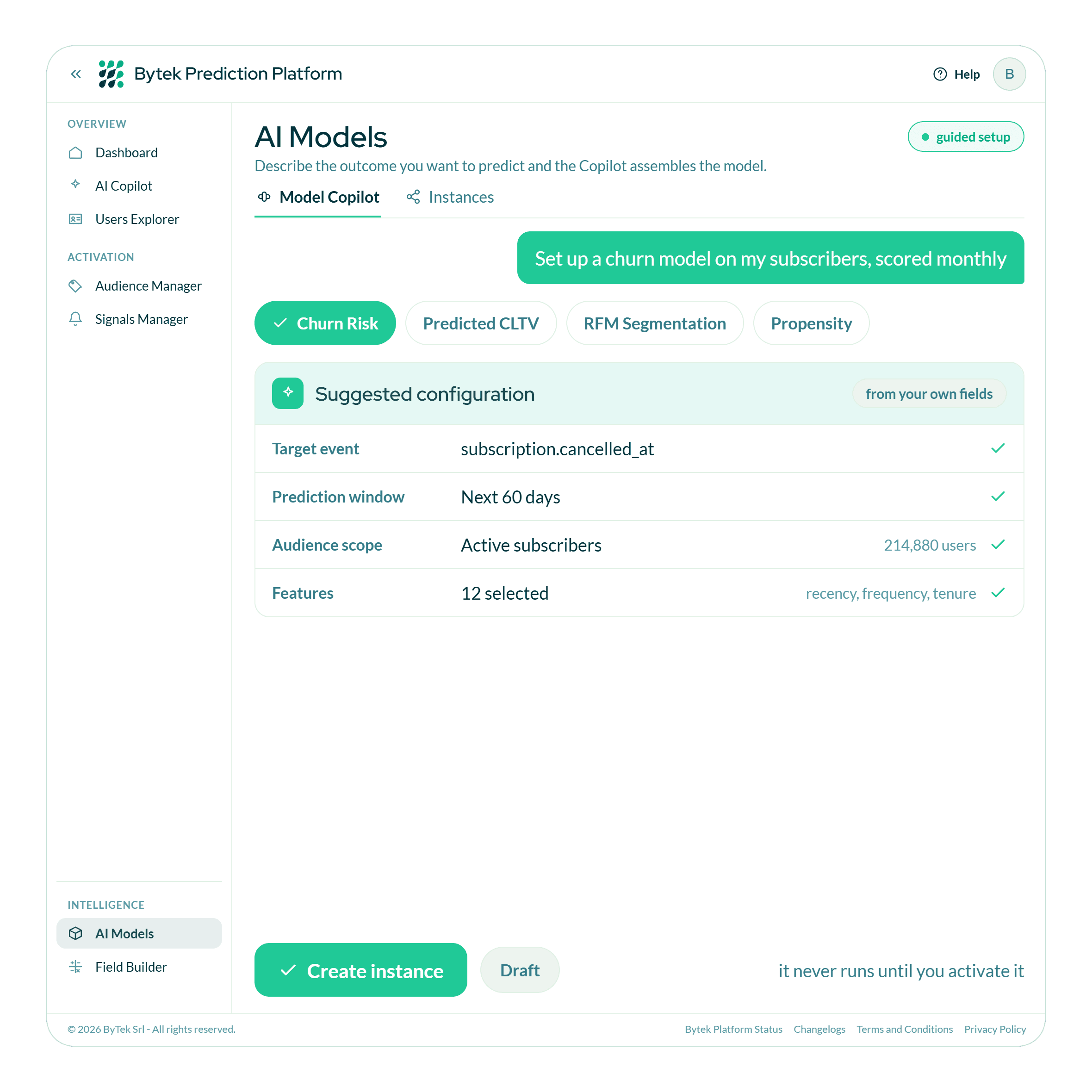
AI Model Copilot guides the configuration, training, and deployment of models such as propensity, churn, predictive Customer Lifetime Value, RFM clustering, and interest classification. Users can begin with the outcome they want to achieve and identify the most suitable model, reducing the need to translate a business requirement into a technical configuration independently.
A marketing team may use it to create a model that estimates purchase probability, identifies customers at risk of churn, predicts future customer value, or segments the customer base according to recency, frequency, and monetary value. The outputs can then support audience creation, the definition of signals sent to advertising platforms, or the personalisation of retention activities.
The Copilot supports the selection of tables, variables, time ranges, and training parameters, making the relationship between input data and expected results easier to understand. The model is initially saved as a draft, allowing the user to review the configuration before activating it and generating predictions.
This approach can bring predictive modelling closer to teams that understand the business problem but do not directly manage every technical stage of the process. Data science expertise remains central to more complex projects, while recurring activities can be handled through a guided, faster, and more structured process.
AI Copilot: accessing BPP capabilities through natural language
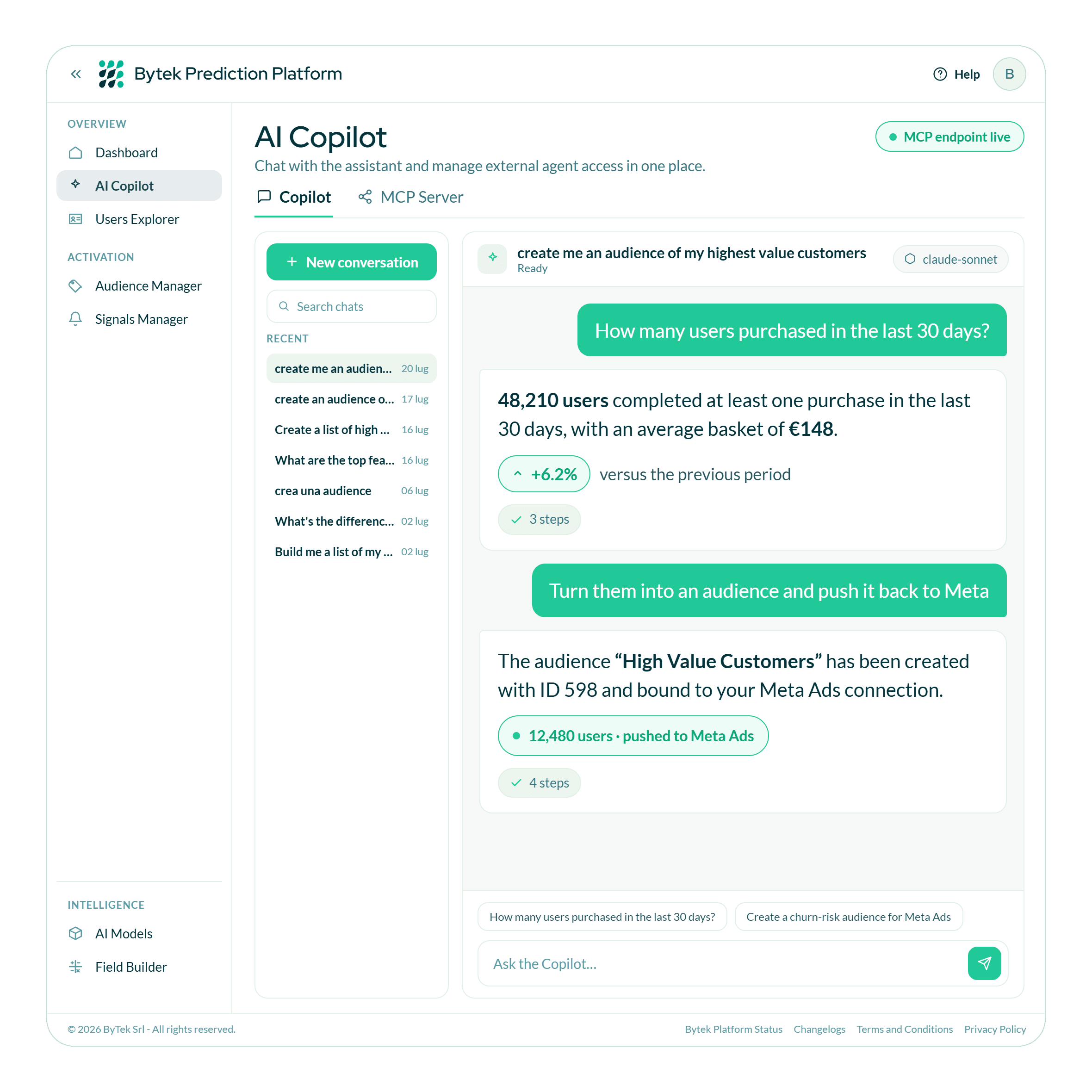
AI Copilot is the conversational assistant integrated into the platform. It allows users to explore their workspace and perform operational activities by directly describing what they want to know or achieve.
Through a natural-language request, users can check which tables and fields are available, assess the quality of a data field, review the number of reconciled profiles in the Identity Graph, see which models are active, or verify the destinations to which an audience is being synchronised.
The Copilot can also support audience and signal creation and management. A user may ask it to create a segment of customers who purchased within the past 30 days, calculate its size before saving, or clone an existing audience with different conditions.
This can reduce the time required to identify the correct functions, configure filters, or move between different sections of the platform. The user can focus on the operational objective while the Copilot identifies the required tools and organises the steps.
Read operations are performed immediately. When an activity involves a change, the Copilot displays a card showing the proposed action, the selected parameters, and the expected effect. The user can approve or reject it, while audiences, signals, and other entities are initially created as drafts.
Users can therefore gain greater autonomy in data exploration and activation while maintaining visibility over the information consulted by the system and control over operations that modify the workspace.
Bytek MCP: using BPP through AI assistants already adopted by the organisation
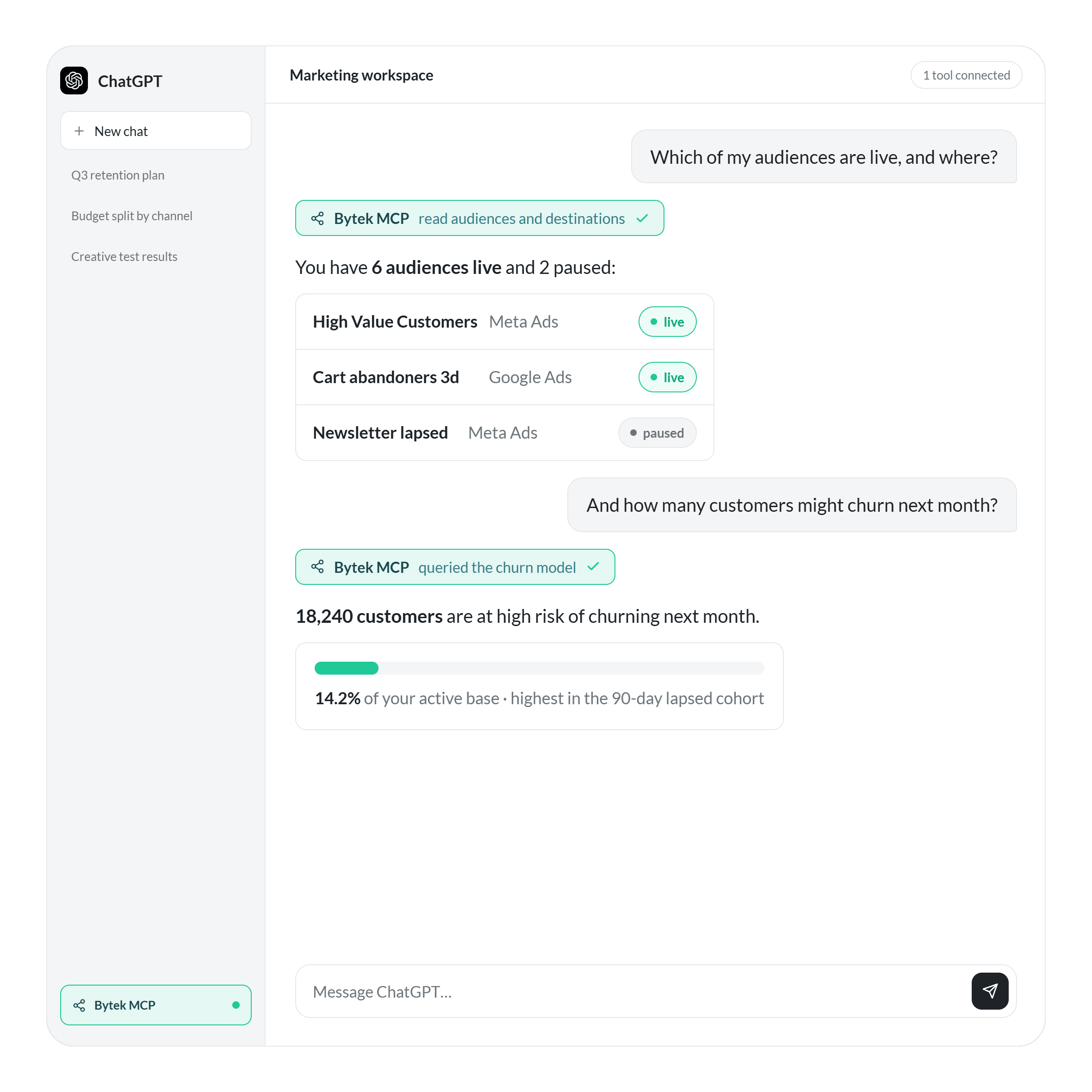
AI Copilot provides agentic capabilities within the platform. Bytek MCP makes selected capabilities available through external assistants compatible with the Model Context Protocol, including Claude and ChatGPT.
For users, this means being able to access BPP while continuing to work within their current environment. From an external AI assistant, they can review data, audiences, signals, connections, and models, run controlled read-only queries, and prepare new drafts for subsequent review within the platform.
A user analysing a campaign strategy in Claude or ChatGPT may, for example, check whether a specific audience already exists, verify which data is available to build it, or prepare a new draft without manually copying information between different systems.
This reduces context switching and integrates BPP into the AI workflows already used by the organisation. Platform capabilities can be accessed from the environment where the team is already working, rather than remaining tied to a single interface.
Access remains personal and limited. Each credential is associated with a specific user and workspace and grants only the permitted operations. External assistants can read information and create drafts, while activation and more sensitive changes remain within BPP.
This gives users greater continuity across data, analysis, and operations while maintaining environment separation, secure access, and oversight of actions.
From interaction to orchestration
Agentic AI introduces a way of accessing platforms in which users can begin with the objective rather than the technical sequence required to achieve it. The agent interprets the request, identifies relevant data and tools, coordinates the steps, and returns a verifiable operational proposal.
This can also affect the relationship between specialist expertise and the everyday use of technology. Technical knowledge remains fundamental to designing infrastructures, models, authorisations, and governance rules. At the same time, more people can access these capabilities without needing detailed knowledge of queries, schemas, and configurations.
The effectiveness of this model depends on the quality of its integration with the operational context. An agent can provide value when it understands the available data, recognises workspace boundaries, uses authorised tools, and makes its proposed operations visible. Without these elements, the interaction may remain disconnected from real processes.
The evolution of interfaces may therefore involve their gradual transformation. Dashboards, filters, and configurations can continue to provide control and detail, while the agentic layer coordinates activities distributed across data, models, and destinations.
In data and marketing platforms, much of the value lies in creating greater continuity between analysis and activation. This involves understanding which information is available, transforming it into segments or predictions, and using it within operational channels through a more direct process.