















Most Customer Data Platform (CDP) initiatives start with great ambition but quickly get stuck in a familiar bottleneck: data unification. Companies often discover that setting up a Marketing Data Warehouse, the very foundation on which all advanced analytics and AI capabilities rely, can take several months. Integrations must be built, schemas aligned, data cleaned, identities matched, and pipelines maintained.
It’s a long journey before any business value can emerge.
At Bytek, we decided that this slow, painful setup model was outdated.
That’s why the Bytek Prediction Platform includes end-to-end support to help you build your Marketing Data Warehouse quickly, intelligently, and with full ownership on your side.
Whether you already have a warehouse in place or are starting from scratch, we help you create a modern, scalable environment where your first-party data becomes instantly actionable.
A Fast, Guided Path to Your Marketing Data Warehouse
If your company doesn’t yet have a Marketing Data Warehouse, we take care of building it with you. Our team supports you in:
Connecting All Your Marketing Data Sources
eCommerce platforms, CRMs, analytics tools, point-of-sale systems, marketing automation tools, ad platforms, the Bytek Prediction Platform integrates with all your key systems.
For many sources, connectors already exist and can be activated in minutes.
A perfect example is Google Analytics 4, which exports data natively into BigQuery. This means that one of the most valuable datasets for marketing – user behavior – becomes immediately available for modeling and analysis, without engineering work or custom pipelines.
Building Automated ETL Pipelines
Our technical team designs and deploys Extraction-Transformation-Loading (ETL) processes tailored to your business and your sources.
These pipelines:
- Clean and normalize your data.
- Align everything to the Bytek ID unified schema.
- Create a consistent, analytics-ready structure.
- Maintain historical logs and user-level tables.
- Once in place, these pipelines run continuously and ensure your warehouse is always fresh and reliable.
Designing a Unified Schema Optimized for Predictions
All data models are aligned to the structures used across the Bytek Prediction Platform, including:
- User Tables, containing attributes and enriched features.
- Event Tables, storing behavioral logs.
- Aggregations, ready for feature engineering and modeling.
- Modeled outputs, written back into your own warehouse.
This architecture enables the platform to operate in zero-copy mode, Bytek does not take your data outside your environment. The entire platform works directly on your warehouse: secure, compliant, and entirely under your control.
Why This Approach Is So Fast
Traditional CDP projects often require rebuilding data infrastructure from scratch, aligning multiple teams, and navigating long internal IT roadmaps. The result is predictable: weeks turn into months before any audience, feature, or predictive model can go live.
Bytek reverses this dynamic.
Because we rely on your own warehouse, leverage native integrations, and follow a proven schema used across dozens of implementations, we can take you from fragmented data to fully operational predictive activation in 2 to 4 weeks.
What accelerates everything:
- Native GA4 > BigQuery streaming, no engineering required.
- Pre-built connectors for CRM, eCommerce, and ad platforms.
- Standardized schemas optimized for marketing and AI.
- Automated ETL templates, quickly adapted to your sources.
- Zero-copy execution, avoiding data replication and extra setups.
This combination gives your team immediate access to clean, unified, enriched data, the kind that usually takes months to prepare.
A Future-Proof Foundation for All Your AI and Audience Use Cases
Once your Marketing Data Warehouse is live, it becomes the single point of truth powering the entire Bytek Prediction Platform:
- Feature Composer lets you create new user attributes without engineering support.
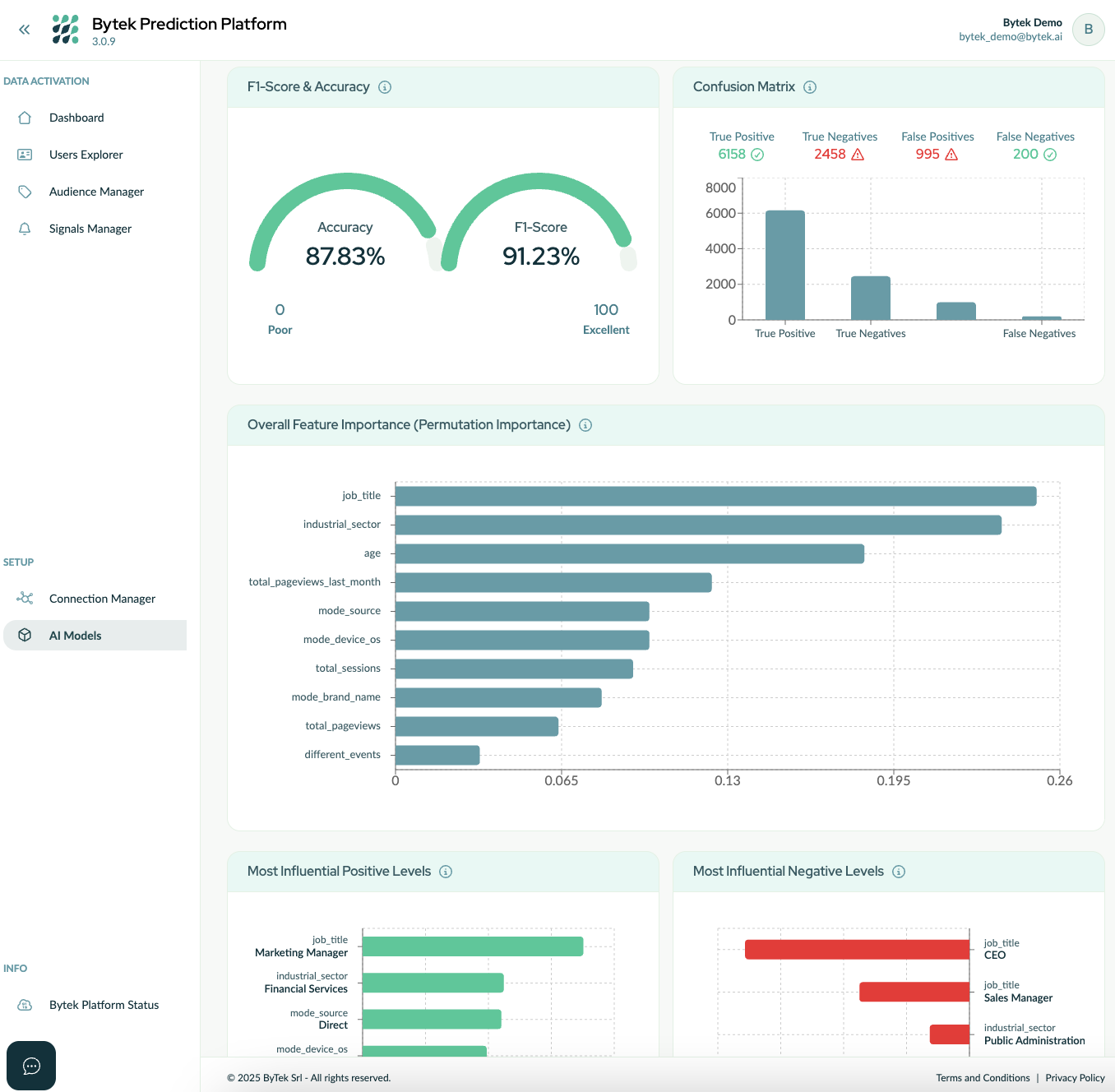
- AI Model Manager trains predictive models directly on your warehouse tables.
- Audience Manager segments users using raw, aggregated, or predicted data.
- Signals Manager sends these predictions and attributes to advertising and marketing platforms.
- User API exposes all unified and modeled data programmatically.
Everything is modular, everything is yours, and everything runs at the speed your business needs.